

By Syed Aoon Sherazi
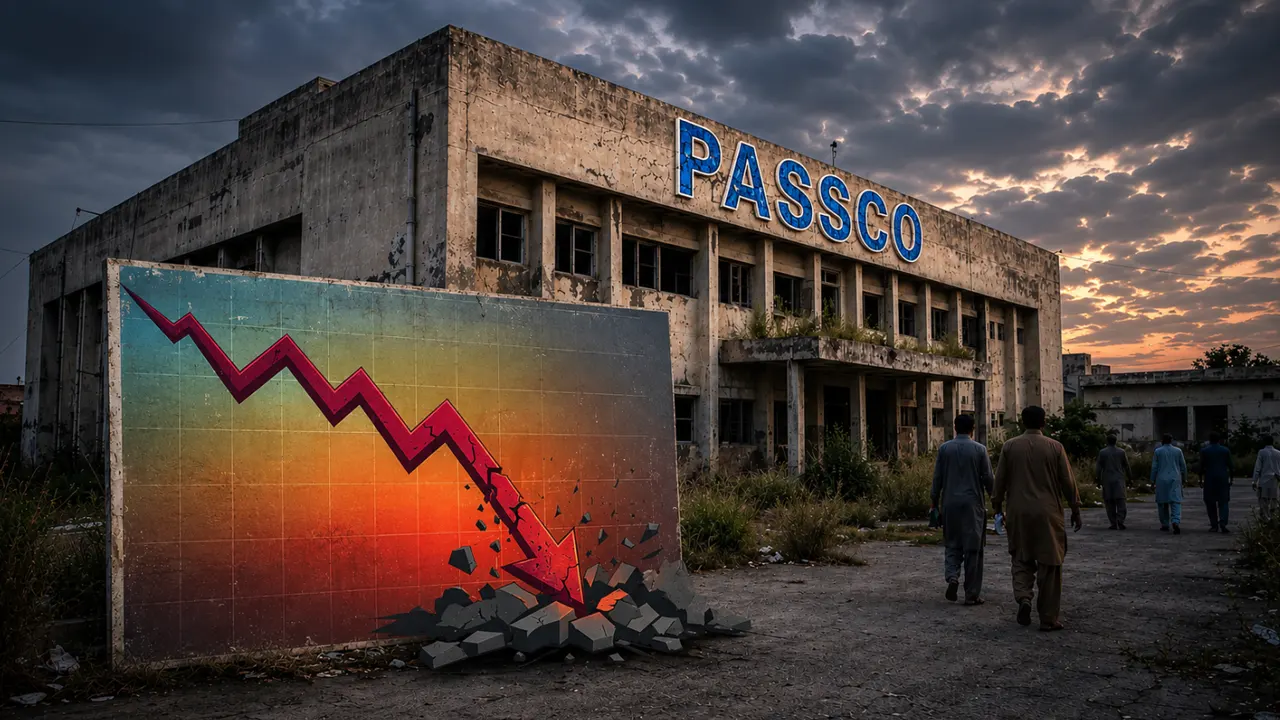
What began as a steady decline in PASSCO’s finances has now erupted into one of the most alarming financial failures within Pakistan’s public sector. Behind the routine procurement and storage of wheat, the state owned corporation quietly slipped from profitability into a debt trap that has cost the national exchequer more than Rs 20.478 billion. The collapse was not sudden it unfolded over several years, raising a troubling question: Were the warning signs ignored, and if so, by whom?
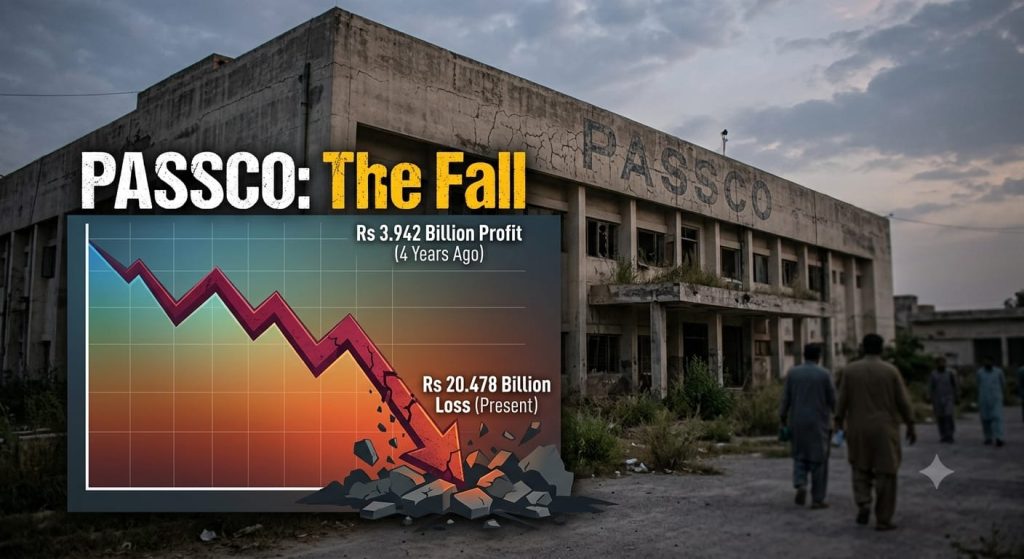
An examination of PASSCO’s audited financial statements for 2021–2025 reveals a disturbing pattern. The Corporation earned a profit of Rs 3.942 billion in 2021, but that figure dwindled to just Rs 419 million by 2023 before plunging into a staggering loss of Rs 20.478 billion in 2025. Its net profit margin has fallen to negative 33.1 percent, meaning that for every Rs 100 it earns, PASSCO now loses approximately Rs 33.
The audit traces the collapse primarily to mounting interest payments on bank loans and poor management of wheat stocks. PASSCO depends on commercial borrowing to finance wheat procurement, making the timely disposal of wheat critical for repaying debt and containing financing costs. Instead, wheat stocks remained in storage while interest on bank loans continued to accumulate. Storage charges, handling expenses, and financing costs kept rising, steadily eroding the Corporation’s profitability until the losses became unsustainable.
Yet the audit points to a deeper governance failure. This financial collapse did not occur overnight. The Corporation’s profits had been shrinking for years, suggesting that warning signals were visible long before PASSCO entered a multi-billion-rupee loss. Despite the deteriorating financial indicators, the audit does not indicate that effective corrective measures were taken in time to arrest the decline.
The audit observation was communicated to PASSCO management on 22 December 2025 and later discussed during the Departmental Accounts Committee (DAC) meeting on 26 January 2026. In its response, the management argued that the losses were largely caused by the failure of federating units and other agencies to fulfill commitments regarding receivables and the lifting of wheat stocks. According to the management, delayed lifting of wheat inventories increased incidental expenses while interest costs continued to mount.
The explanation, however, opens the door to even more uncomfortable questions. If federating units failed to lift wheat as agreed, why did PASSCO continue accumulating debt without developing an alternative strategy? Why was the Corporation allowed to continue paying massive interest on borrowed funds while stocks remained unsold? And why did the Board of Directors and the supervising ministry fail to intervene as profitability steadily disappeared?
Accountability appears to rest at multiple levels. PASSCO’s management was responsible for operational decisions, financial planning, debt management, and inventory control. The Board of Directors was expected to oversee the Corporation’s financial health, scrutinize management decisions, and ensure timely corrective action. The Ministry of National Food Security and Research, which exercises administrative oversight of PASSCO, was responsible for monitoring the Corporation’s performance and addressing emerging financial risks. If the management’s explanation is accurate, the federating units and agencies that failed to lift wheat stocks or clear receivables also bear responsibility for aggravating the crisis.
Recognizing the gravity of the situation, the DAC directed PASSCO to prepare a recapitalization mechanism and a debt restructuring plan, duly approved by its Board of Directors, for submission to the Ministry of National Food Security and Research. The audit has recommended immediate implementation of these directives.
The audit paints the picture of a crisis that was years in the making. It raises serious concerns about whether weak governance, delayed decision making, poor financial management, and ineffective oversight allowed a profitable public institution to slide into a massive financial loss. More importantly, it leaves behind a question that remains unanswered: Was this simply administrative incompetence, or did systemic failures across multiple institutions allow billions of rupees in public money to slip away without timely intervention?