
Syed Aoon Sherazi
Editor’s note: Syed Aoon Sherazi is a Pakistani journalist, international affairs analyst, and regular columnist for international publications. A frequent commentator on national and international TV channels, he specializes in Pakistan, China, the United States, the Middle East, Afghan affairs, geopolitics, and strategic affairs.
Baluchistan is far more than Pakistan’s largest province. Covering nearly 44 percent of the country’s total landmass, it represents Pakistan’s strategic gateway to the Arabian Sea, the Middle East, Central Asia, and beyond. Blessed with immense natural wealth, a long coastline, diverse cultures, and enormous economic potential, Baluchistan has the capacity to become one of South Asia’s most prosperous regions. Yet for decades, its progress has been repeatedly challenged by terrorism, instability, and efforts aimed at undermining Pakistan’s national development agenda.
The province is home to a rich demographic mosaic. Baloch, Pashtun, Brahui, Hazara, Sindhi, Punjabi, and several smaller communities have lived together for generations, contributing to Baluchistan’s unique cultural identity. Contrary to the perception often portrayed by hostile narratives, Baluchistan is not defined by conflict but by resilient people who aspire to education, employment, healthcare, and economic opportunities. The overwhelming majority of its citizens reject violence and seek peace, stability, and prosperity for future generations.
Nature has blessed Baluchistan with extraordinary resources. It possesses vast reserves of natural gas, copper, gold, coal, chromite, marble, iron ore, and other valuable minerals. The world-class Reko Diq copper and gold reserves are expected to become one of the largest mining projects globally, while the Saindak Copper-Gold Project continues to contribute to Pakistan’s mining sector. The province also supports one of Pakistan’s largest fisheries industries through its coastline of more than 700 kilometres. Its fertile valleys produce internationally recognized apples, grapes, cherries, peaches, almonds, pistachios, dates, and other fruits that contribute significantly to the national economy.
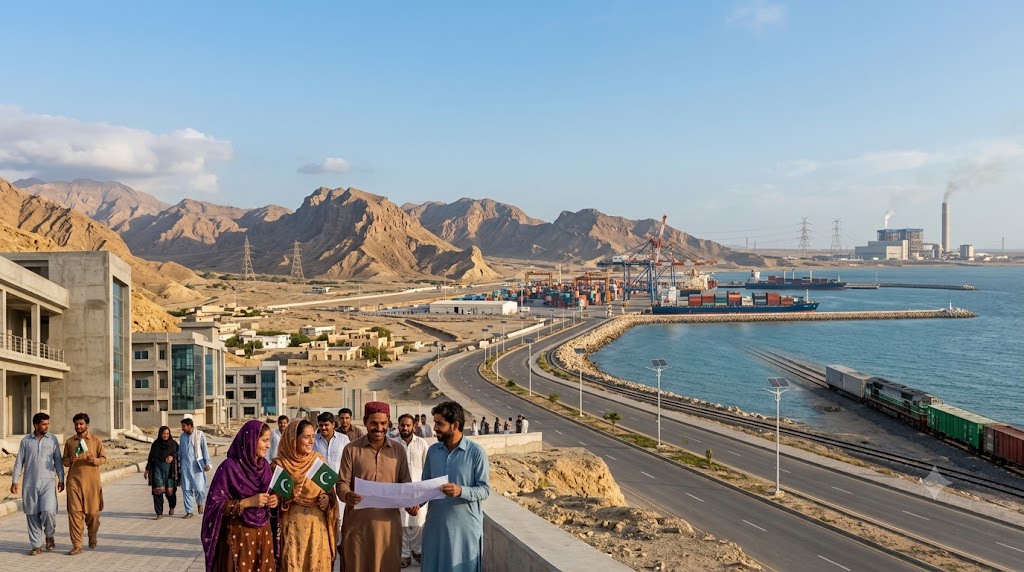
No discussion of Baluchistan can be complete without acknowledging the transformational importance of Gwadar Port. Located near one of the world’s busiest maritime trade routes, Gwadar has emerged as the centrepiece of the China-Pakistan Economic Corridor (CPEC). Modern highways, expressways, hospitals, schools, vocational institutes, desalination plants, electricity projects, the Gwadar Free Zone, and the New Gwadar International Airport are gradually transforming the region into an emerging commercial hub. These projects are not merely infrastructure investments; they represent opportunities for employment, industrialization, regional connectivity, and long-term economic growth for the people of Baluchistan.
During the past several years, both the federal and provincial governments have increased investment in infrastructure, education, healthcare, digital connectivity, and social welfare. Thousands of students from Baluchistan have received scholarships to study in leading educational institutions across Pakistan. New road networks have connected remote districts with major urban centres, reducing travel time and improving access to markets, hospitals, and educational facilities. Water supply schemes, rural electrification, and renewable energy initiatives have further enhanced the quality of life in many previously underserved areas. Although much work remains to be done, these initiatives reflect a sustained commitment to integrating Baluchistan into Pakistan’s broader development framework.
Unfortunately, the province has also suffered from decades of terrorism carried out by organizations such as the Baluchistan Liberation Army (BLA), the Baloch Republican Army (BRA), and other terrorist groups. These organizations have repeatedly targeted innocent civilians, teachers, doctors, engineers, laborers, students, security personnel, and public infrastructure. They have attacked schools, roads, communication networks, railway lines, and development projects, creating fear among local communities and discouraging investment. The greatest victims of these terrorist attacks have been the ordinary people of Baluchistan whose aspirations for peace and economic progress have repeatedly been disrupted.
The activities of these terrorist organizations have particularly focused on projects that promise long-term prosperity, including CPEC-related infrastructure and Gwadar Port. Such attacks are intended not only to inflict casualties but also to damage investor confidence, delay development, and create an environment of instability. Every attack on a school, construction site, or public institution directly harms the people of Balochistan by slowing economic growth and reducing employment opportunities.
Pakistan has consistently maintained that hostile external actors have sought to exploit unrest in Baluchistan by supporting anti-state terrorist organizations. Pakistani governments, military leadership, and security institutions have repeatedly stated that India’s intelligence agency, RAW, has provided financial, logistical, and operational support to terrorist networks operating inside Baluchistan with the objective of destabilizing Pakistan and sabotaging strategic national projects, particularly CPEC and Gwadar Port. According to Pakistan’s official position, such support forms part of a broader strategy to create instability and undermine Pakistan’s economic and security interests.
Despite these security challenges, Pakistan’s armed forces and law enforcement agencies have remained steadfast in defending the province against terrorism. The Pakistan Army, Frontier Corps Baluchistan, Police, Levies Force, Coast Guards, and intelligence agencies have rendered extraordinary sacrifices in protecting innocent citizens and safeguarding national infrastructure. Thousands of officers and soldiers have embraced martyrdom while fighting terrorism, demonstrating exceptional courage, professionalism, and unwavering commitment to Pakistan’s sovereignty. Their sacrifices have enabled many districts once affected by insecurity to return gradually toward normalcy.
The recently launched Operation Shabaan represents another significant step in Pakistan’s comprehensive counterterrorism strategy. Conducted through close coordination between the Pakistan Army, Frontier Corps, intelligence agencies, Police, and other law enforcement institutions, the operation aims to dismantle terrorist networks, destroy their hideouts, eliminate their logistical infrastructure, and restore lasting peace across affected regions. The operation reflects the state’s determination to ensure that terrorist organizations cannot hold the future of Baluchistan hostage. Every successful operation not only weakens terrorist capabilities but also creates space for schools to reopen, businesses to expand, investors to return, and development projects to move forward. The professionalism, discipline, and sacrifices of Pakistan’s security forces deserve appreciation for protecting both national security and the future of the people of Baluchistan.
Military operations alone, however, cannot guarantee lasting peace. Sustainable stability depends upon economic opportunity, inclusive governance, education, healthcare, and meaningful participation of local communities in development. Pakistan has increasingly adopted a comprehensive approach that combines effective security measures with social and economic development. Youth empowerment programs, scholarships, vocational training, entrepreneurship initiatives, healthcare expansion, and infrastructure development are helping create opportunities for a new generation determined to build a peaceful and prosperous Baluchistan.
The future of Baluchistan lies not in conflict but in connectivity, investment, education, and development. Its strategic location, abundant mineral wealth, expanding transport infrastructure, growing maritime significance, and dynamic population provide an unparalleled opportunity to transform the province into a regional centre of trade and industry. Defeating terrorism, protecting critical infrastructure, strengthening democratic institutions, and ensuring that the benefits of development reach every district will remain essential for realizing this vision.
Baluchistan’s story should therefore not be written through the lens of violence alone. It is equally a story of resilience, opportunity, sacrifice, and hope. The courage of its people, the commitment of Pakistan’s armed forces and law enforcement agencies, and the state’s continued investment in development provide strong foundations for a future defined by peace, stability, and shared prosperity. As Gwadar grows, Reko Diq advances, infrastructure expands, and security continues to improve, Baluchistan is steadily moving toward becoming one of the most strategically important and economically vibrant regions of Pakistan.