
By Fact Line Investigations
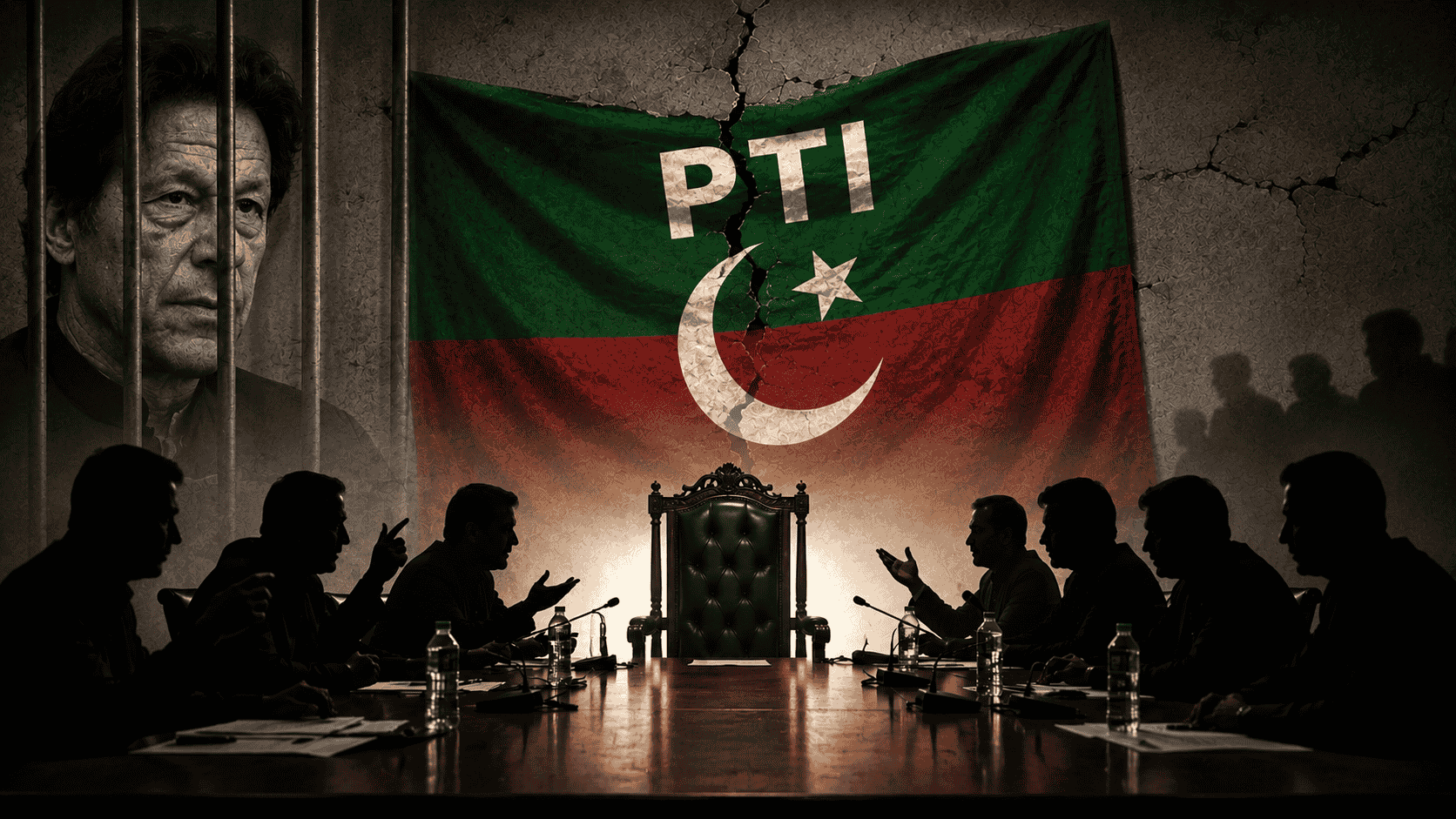
Pakistan Tehreek-e-Insaf (PTI) has long projected itself as a movement united under the leadership of its founder, Imran Khan. But nearly nine months without direct communication with the jailed party chief have exposed growing internal divisions, competing factions and leadership disagreements that many political observers believe are undermining the party’s effectiveness at a critical time.
Senior party leaders privately acknowledge that the prolonged absence of direct guidance from the founder has made decision making significantly more difficult. Matters that were once settled quickly through his intervention now require lengthy consultations, often ending in disagreements rather than consensus. The resulting leadership vacuum has made internal differences increasingly visible and has fuelled uncertainty over the party’s political direction.
While PTI continues to face political pressure from outside, the party is also grappling with challenges from within. Internal competition for influence, organisational control and key party positions has intensified during the prolonged absence of its central leadership. Political analysts say that without a single authority capable of resolving disputes, rival groups have gained greater space to promote their own strategies and priorities.
Over the past several months, Pakistani television talk shows, political commentators and news reports have repeatedly highlighted differences among senior PTI leaders over protest plans, negotiations, parliamentary strategy and organisational matters. Conflicting public statements by party figures have often created confusion among workers and supporters regarding the party’s next course of action.
Political commentators have also debated the increasingly visible role of Imran Khan’s sisters since the former prime minister’s imprisonment. Their public appearances and advocacy for his release have led to discussion among analysts and PTI supporters about whether family members have become more influential in shaping the party’s political narrative during the prolonged absence of direct communication with the party founder. PTI has not formally recognised any organisational role for family members in its decision-making, and differing assessments of their influence remain the subject of political debate.
Another debate that has increasingly surfaced within political circles concerns several senior PTI figures who distanced themselves from the party following the crackdown after Imran Khan’s imprisonment. Some political analysts and PTI supporters believe these experienced politicians possessed the organisational strength, political influence and negotiating ability to help build broader political pressure for Imran Khan’s release had they remained active within the party. They also argue that the return of some former leaders could strengthen PTI’s political campaign. Others, however, contend that sections of the current leadership may be reluctant to see influential former figures return because it could alter the party’s internal balance of power. These competing views remain part of Pakistan’s ongoing political debate and have not been established as fact.
Another major challenge has emerged on social media, where competing narratives have deepened divisions within the party. According to senior party circles, three distinct groups have become increasingly active. One consists of individuals associated with political opponents who seek to shape public opinion against PTI. Another includes party insiders pursuing influential organisational positions and viewing certain leaders as obstacles to their ambitions. The third comprises passionate supporters who sincerely want Imran Khan released but frequently demand immediate political action without fully appreciating the strategic and organisational constraints facing the party.
The emergence of these competing voices has intensified internal tensions. Instead of presenting a unified political message, PTI has increasingly found itself responding to controversies generated by rival camps, personal criticism and disputes over leadership. These disagreements have often dominated public discussion, shifting attention away from the issue that remains most important to the party’s supporters the release of Imran Khan.
Criticism has also increasingly been directed at PTI’s government in Khyber Pakhtunkhwa. Opposition parties, governance experts and some PTI supporters argue that the provincial administration has not delivered at the pace many voters expected in areas such as public services, development, employment and local government. They contend that stronger governance could have reinforced PTI’s national political narrative and strengthened public confidence while the party campaigns for Imran Khan’s release. PTI leaders, however, maintain that fiscal constraints, security challenges and disputes with the federal government have limited the province’s ability to fully implement its agenda.
Political observers argue that every major opposition movement depends on organisational discipline, particularly when its central leader is absent. In PTI’s case, however, prolonged uncertainty has allowed personal ambitions and competing strategies to become more prominent. Calls for immediate protests, negotiations or confrontational politics frequently compete with arguments for patience, planning and long-term political organisation.
Within the party there is broad agreement that emotional slogans alone cannot achieve political objectives. Large gatherings or isolated demonstrations, many believe, are unlikely to produce meaningful political change without careful planning, coordinated leadership and a sustainable strategy. The challenge is not merely mobilising supporters but translating public sentiment into an organised political movement.
The growing debate has also raised uncomfortable questions among party workers. While nearly every PTI leader publicly declares that securing Imran Khan’s release remains the party’s highest priority, much of the political conversation in recent months has centred on internal rivalries, organisational disputes, disciplinary matters and leadership differences. For many supporters, this has created the impression that internal politics is beginning to overshadow the struggle for the party founder’s freedom.
Political analysts believe PTI continues to enjoy considerable public support because of Imran Khan’s personal popularity. However, they warn that sustained internal fragmentation could weaken the party’s ability to capitalise on that support. A movement that derives much of its strength from a single leader inevitably faces serious organisational challenges when that leader cannot directly guide political and strategic decisions.
The absence of regular communication with the party founder has therefore become more than a logistical problem. It has evolved into a political challenge that affects unity, decision making and organisational discipline. As different groups compete to influence the party’s future, PTI faces perhaps its most significant internal test since its formation.
Whether the party can overcome these divisions may ultimately determine not only its political future but also its ability to keep the focus on the issue that continues to unite its supporters: the release of Imran Khan. Until a cohesive leadership emerges or direct guidance from the party founder is restored, internal disagreements and competing interests are likely to remain one of PTI’s biggest challenges.