

Fabaha Fatima
Psychologist
Fabaha Fatima is a psychologist and columnist whose work focuses on psychology, mental health, and contemporary social issues, offering evidence based insights into human behavior and well being.
There was a time when university life was widely regarded as one of the most memorable phases of a person’s life a period of intellectual growth, lifelong friendships, and the excitement of discovering one’s identity. Today, however, for many students, university has become synonymous with chronic stress, anxiety, uncertainty, and emotional exhaustion.
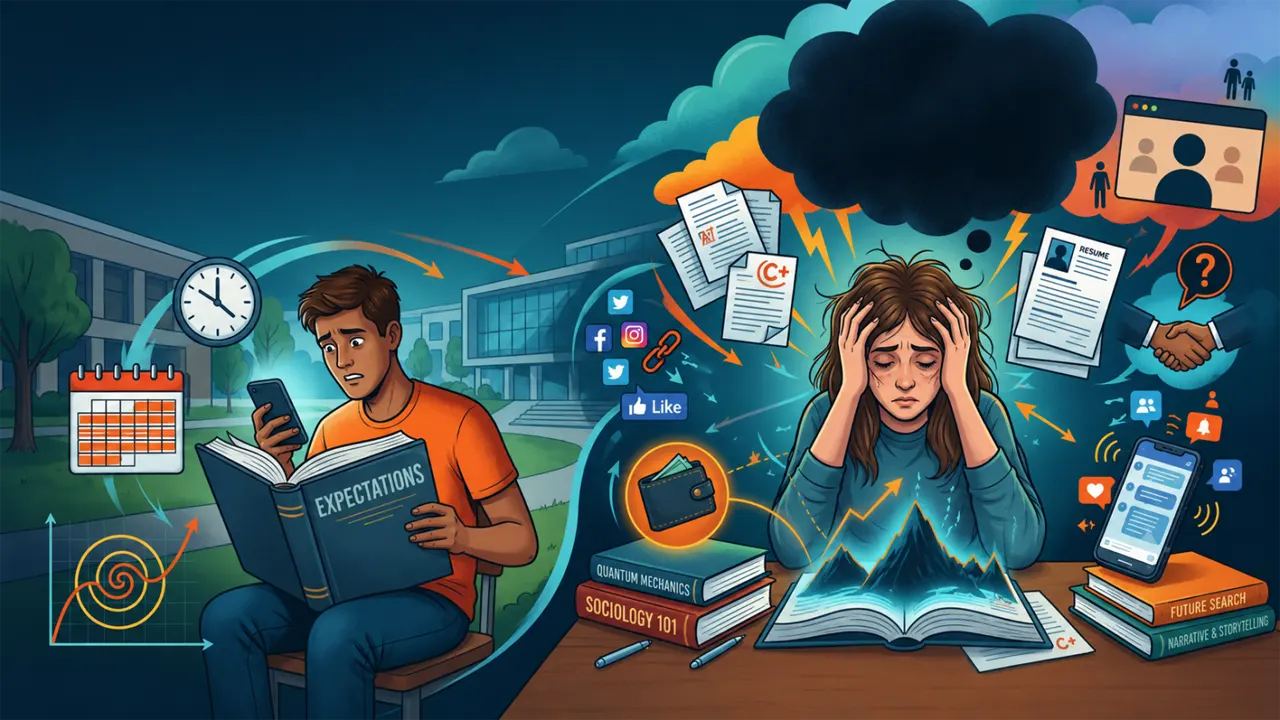
As a psychologist, I have observed that today’s university students are not necessarily weaker than previous generations. On the contrary, they are navigating a far more complex world. They are expected to excel academically, remain active on social media, develop professional skills, secure internships, satisfy family expectations, and prepare for an increasingly competitive job market all at the same time. The pressure is relentless.
Stress itself is not the enemy. In psychology, we recognize that moderate stress can improve motivation and performance. The problem arises when stress becomes constant, overwhelming, and inescapable. Unfortunately, this is the reality for many university students today.
One of the biggest sources of stress is academic pressure. Higher education has become increasingly competitive, and students often feel that a single poor semester could jeopardize their entire future. Many spend sleepless nights preparing for examinations, completing assignments, and meeting deadlines. Instead of learning for personal and intellectual development, education often becomes a race for grades.
I once spoke with a student who maintained an excellent academic record but confessed that she dreaded opening her university portal because every notification triggered anxiety. Her fear was not failure itself it was disappointing her parents, who had invested their savings in her education. This illustrates an important psychological reality: stress is shaped not only by external events but also by the meaning we attach to them.
Family expectations add another layer of emotional burden. In many Pakistani households, higher education is viewed as the pathway to financial stability and social mobility. While these expectations are often rooted in love and sacrifice, students may interpret them as immense pressure. They begin to believe that any setback would amount to letting their families down.
Economic uncertainty has further intensified student anxiety. Previous generations often believed that a university degree would naturally lead to employment. Today, that certainty has largely disappeared. Many graduates struggle to find jobs despite possessing impressive academic credentials. Current students witness this reality and begin worrying long before graduation.
This uncertainty creates what psychologists describe as anticipatory anxiety , persistent worry about events that have not yet occurred. Students are not only coping with today’s assignments; they are also burdened by tomorrow’s unknowns.
Social media has transformed university life in ways few anticipated. While these platforms connect people, they also create endless opportunities for comparison. Students constantly encounter posts showcasing scholarships abroad, entrepreneurial success, luxury lifestyles, and seemingly perfect achievements.
Psychologically, people tend to compare their behind the scenes struggles with everyone else’s carefully curated highlights. This distorted comparison often damages self esteem and creates the illusion that everyone else is progressing faster.
The fear of missing out, commonly known as FOMO, has become a significant source of psychological distress. Many students feel guilty if they are not attending every seminar, mastering every new skill, or building an impressive online profile. Ironically, in trying to do everything, they often become emotionally exhausted.
Another overlooked issue is loneliness.
University campuses are full of people, yet many students report feeling profoundly isolated. Technology has increased communication but has not necessarily strengthened meaningful relationships. Genuine conversations are increasingly replaced by brief digital interactions.
Human beings are inherently social. Emotional support from trusted friends serves as a protective factor against anxiety and depression. When students lack such support systems, everyday stressors become significantly harder to manage.
The COVID-19 pandemic also left lasting psychological effects. Many students entered university after prolonged periods of online education, social isolation, and disrupted routines. Some continue to experience difficulties concentrating, rebuilding confidence, and reconnecting socially.
Mental health stigma remains another serious challenge. Even educated individuals often hesitate to seek psychological support because they fear being judged as weak or unstable. Consequently, many students suffer in silence until their difficulties begin affecting academic performance, physical health, and relationships.
Universities themselves must recognize that mental health is not separate from academic success. A student struggling with severe anxiety cannot perform at their intellectual best, regardless of ability. Counseling services should not be viewed as optional facilities but as essential components of higher education. Professional psychologists, peer support initiatives, stress management workshops, and faculty awareness programs can make a measurable difference.
Teachers also have an important role. A supportive lecturer who listens, provides constructive feedback, and demonstrates empathy can significantly reduce a student’s stress. Small acts of understanding often leave lasting psychological benefits.
Parents, too, should remember that encouragement is more powerful than constant pressure. Students need reassurance that their worth extends beyond grades or career outcomes. Feeling accepted despite setbacks strengthens resilience and promotes healthier coping mechanisms.
Students themselves should understand that perfection is neither realistic nor necessary. Self care is not laziness. Adequate sleep, regular physical activity, realistic expectations, and seeking help when needed are all evidence based strategies for maintaining psychological well being.
Perhaps the most important lesson is that success should never come at the cost of mental health. A degree may open professional doors, but emotional resilience determines how effectively individuals navigate life beyond university.
Universities are not merely institutions that produce graduates; they shape future leaders, professionals, researchers, and citizens. If we continue to ignore students’ psychological well being, we risk producing academically qualified individuals who are emotionally exhausted.
It is time to redefine educational success. Alongside academic excellence, universities must foster resilience, emotional intelligence, empathy, and psychological well being. Only then can higher education truly prepare young people not just for employment, but for life.